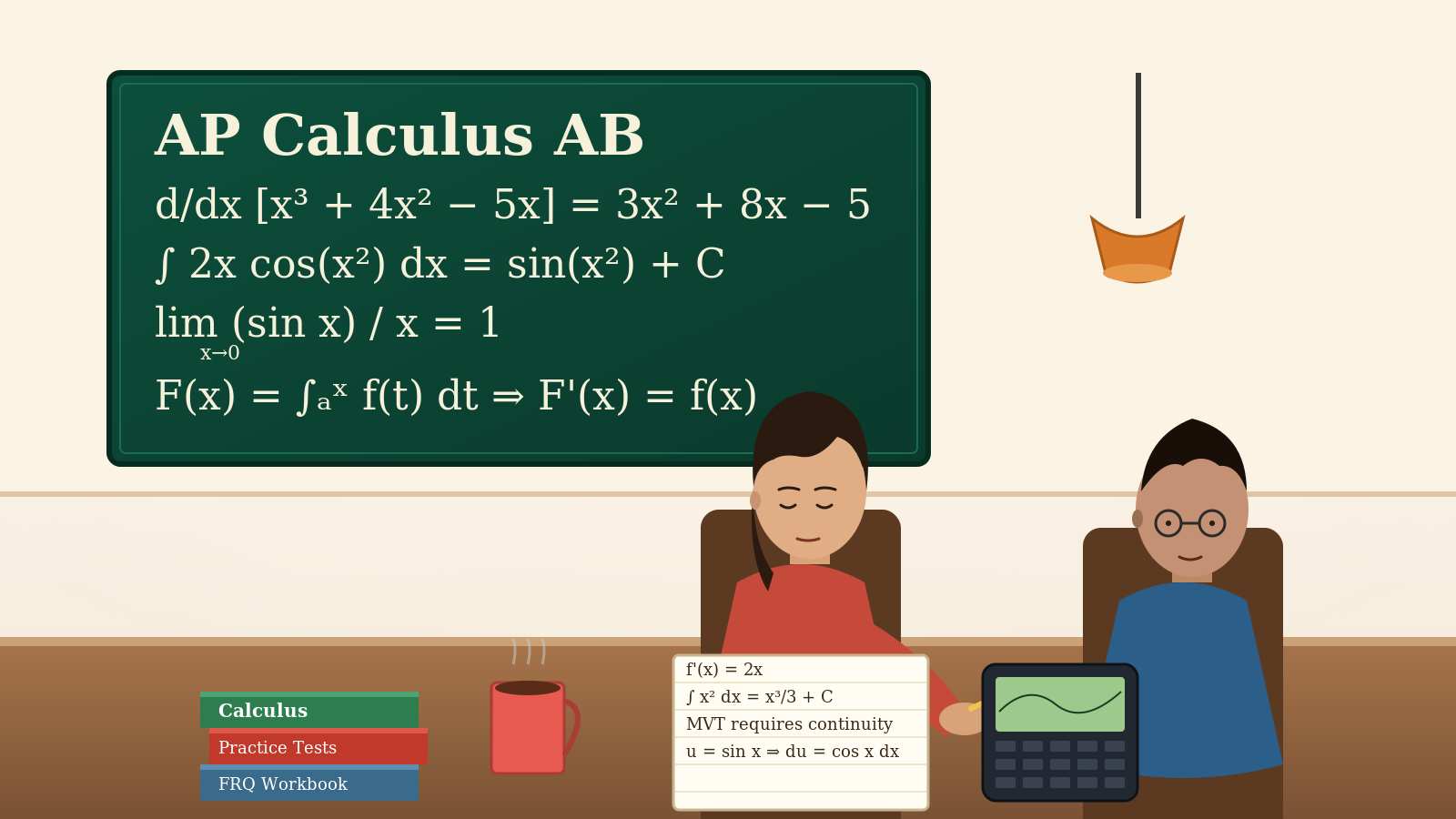
The AP Calculus AB exam in 2026 keeps the same nine units, the same calculator policy, and the same scoring scale that has guided College Board’s flagship math exam for years. What has changed is the depth of the FRQ rubrics, the way the Bluebook style digital readiness affects pacing on paper, and the exam day expectations around showing setup work. If you are aiming for a 5, you need a study plan that treats Calculus AB as both a conceptual class and a procedural sport.
This guide walks you through everything you need to score a 5 on AP Calculus AB in 2026, including a 10 week study plan, the highest yield topics, FRQ scoring habits that earn the partial credit students leave behind, and a list of the exact practice resources that move scores the most.
Table of Contents
- 2026 AP Calculus AB exam format
- Scoring and what a 5 actually requires
- The nine units and weight on the exam
- 10 week AP Calculus AB study plan
- How to earn every FRQ point
- Calculator strategy on Section I Part B and Section II Part A
- Common mistakes that cost a 5
- Sample question with full walkthrough
- FAQ
2026 AP Calculus AB Exam Format
The AP Calculus AB exam in 2026 is 3 hours and 15 minutes long. It has two sections of equal weight.
Section I Multiple Choice contains 45 questions in 1 hour and 45 minutes. Part A has 30 questions in 60 minutes with no calculator. Part B has 15 questions in 45 minutes with a graphing calculator allowed.
Section II Free Response contains 6 questions in 1 hour and 30 minutes. Part A has 2 questions in 30 minutes with a graphing calculator. Part B has 4 questions in 60 minutes with no calculator.
Each section is worth 50 percent of your composite score. The College Board converts your raw score into the familiar 1 to 5 scale, with a 5 typically requiring around 67 to 72 percent of the available points.
Scoring and What a 5 Actually Requires
In recent administrations, students who scored a 5 averaged roughly 38 of 45 multiple choice points and 36 of 54 FRQ points. That confirms a pattern many tutors recognize: you do not need to be perfect on the FRQs to earn a 5, but you do need to be consistent on the multiple choice section. Treat the no calculator multiple choice as your bedrock and aim for 27 of 30 there.
The Nine Units and Weight on the Exam
College Board publishes weighting bands every year. For 2026 the practical weights are as follows.
Unit 1: Limits and Continuity covers about 10 to 12 percent. Expect questions on one sided limits, indeterminate forms, and the Intermediate Value Theorem. Easy points if you know the algebra of limits cold.
Unit 2: Differentiation Definition and Fundamental Properties covers about 10 to 12 percent. The limit definition of the derivative still appears, especially in disguise.
Unit 3: Differentiation Composite Implicit and Inverse Functions covers about 9 to 13 percent. Chain rule and implicit differentiation dominate.
Unit 4: Contextual Applications of Differentiation covers about 10 to 15 percent. Related rates, linearization, and L’Hopital’s Rule.
Unit 5: Analytical Applications of Differentiation covers about 15 to 18 percent. The biggest single weight. Mean Value Theorem, intervals of increase or decrease, concavity, and optimization.
Unit 6: Integration and Accumulation of Change covers about 17 to 20 percent. The other heavy hitter. Riemann sums, the Fundamental Theorem of Calculus, and u substitution.
Unit 7: Differential Equations covers about 6 to 12 percent. Slope fields and separation of variables.
Unit 8: Applications of Integration covers about 10 to 15 percent. Area between curves, volumes by disks, washers, and known cross sections.
If you sum the central values, Units 5, 6, and 8 together account for almost half the test. Plan your study time accordingly.
10 Week AP Calculus AB Study Plan
This plan assumes you already finished the AP Calculus AB course. If you are learning from scratch, double the timeline.
Weeks 1 and 2: Limits, Continuity, and Derivative Definitions. Rebuild Units 1 through 3. Spend one full evening on the limit definition of the derivative because it is one of the most disguised topics on the multiple choice section. Do 40 mixed practice problems each week.
Week 3: Chain Rule, Implicit, and Inverse Functions. The chain rule is the single biggest source of careless errors. Drill until the answer comes out without a notebook step. Practice 30 problems including 10 inverse trig derivatives.
Week 4: Applications of Differentiation. Related rates, linear approximation, L’Hopital’s Rule. Do at least 15 related rates problems. Build a personal cheat sheet of the seven most common related rates setups: ladder, expanding circle, expanding sphere, inverted cone draining, shadow length, baseball diamond, and water trough.
Week 5: Analytical Applications and the MVT. Master the sign analysis tables for first and second derivatives. Memorize the precise statement of the Mean Value Theorem and the Extreme Value Theorem because graders deduct for sloppy hypotheses.
Week 6: Integration Foundations. Riemann sums in all four flavors (left, right, midpoint, trapezoidal), the Fundamental Theorem of Calculus in both forms, and u substitution. Do 50 antiderivative problems by hand. No calculator.
Week 7: Differential Equations. Slope fields, separation of variables, exponential growth and decay, and the logistic equation form. Practice writing the differential equation from a verbal scenario.
Week 8: Applications of Integration. Area between curves, volumes by disks, volumes by washers, and volumes by known cross sections. Build a habit of always sketching the region first.
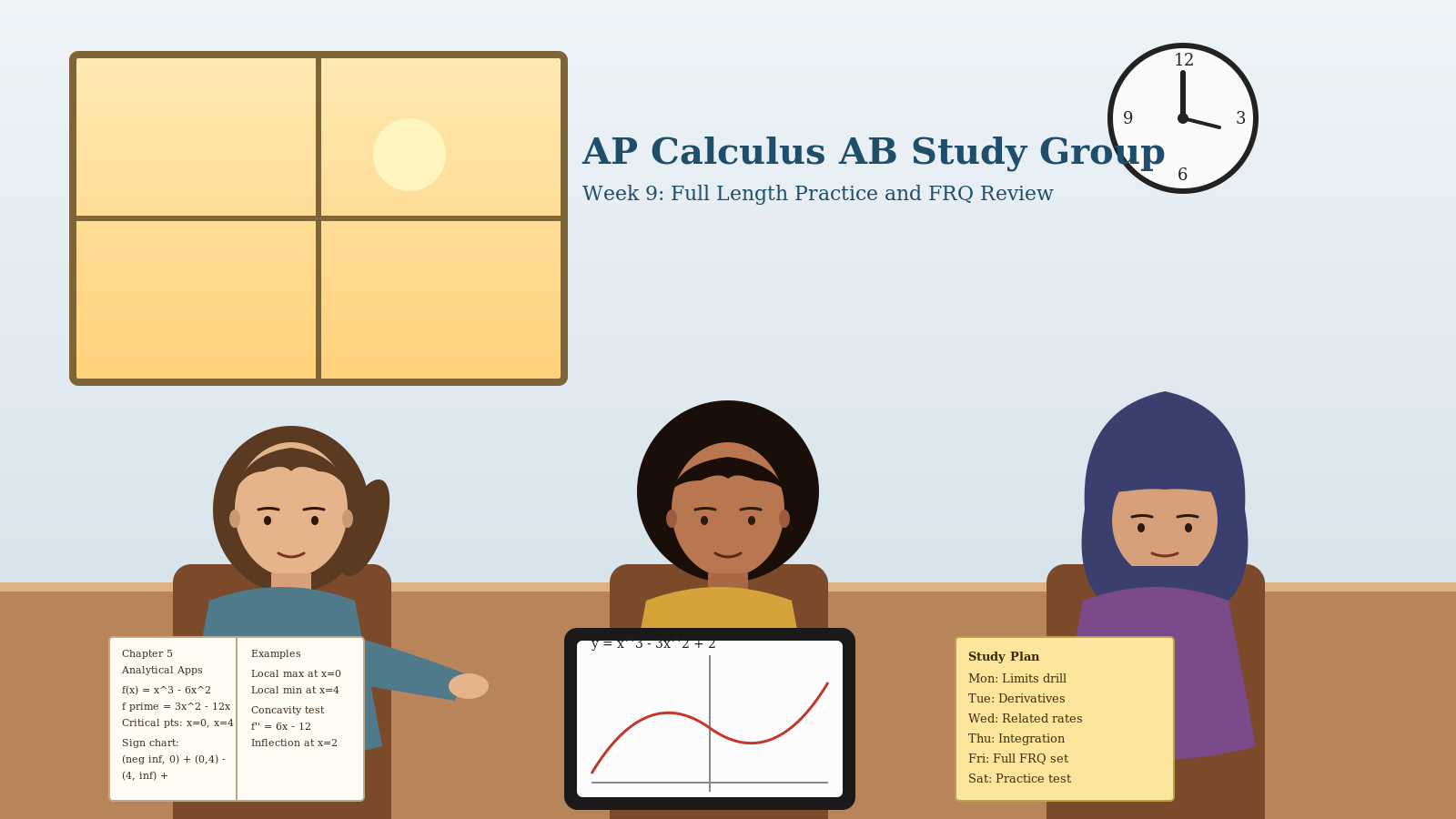
Week 9: Full Length Practice Tests. Take two full released exams under timed conditions. Score them honestly using the published rubrics. Map every missed question to a unit and reteach yourself that topic the next day.
Week 10: Targeted Review and FRQ Drills. Spend three days on the two units where you missed the most points. Spend two days drilling FRQs only, focusing on showing the setup work that earns the bulk of partial credit. Do a light review the day before the exam, sleep early, and bring two calculators with fresh batteries.
How to Earn Every FRQ Point
FRQ scoring is mechanical. Each part is worth a small number of points and graders look for specific words, expressions, or setups. The students who score 5s have learned the rubric language.
Always show the integral or derivative setup before evaluating. Writing the answer alone earns 1 point at most. Writing the setup earns the setup point even if you compute the value wrong. On most FRQs the setup is worth more than the numeric answer.
Use units when units are given. If the question states cubic feet per minute, your final answer needs cubic feet per minute. Missing units routinely costs a point on every exam.
Justify with the named theorem. When you use the Mean Value Theorem, write out that the function is continuous on the closed interval and differentiable on the open interval. When you use the Intermediate Value Theorem, state the continuity hypothesis. Graders are looking for those exact words.
Round only at the end. Carry at least three decimal places through intermediate steps. The College Board rubric accepts answers within plus or minus 0.001 of the official value.
Do not erase calculator work. If the question is in Part A and a calculator is allowed, write the integral expression first, then write the numeric answer. Both must appear.
Calculator Strategy on Section I Part B and Section II Part A
The four calculator skills you must have automatic are: graphing a function and finding a zero, finding the value of a derivative at a point, evaluating a definite integral, and finding the intersection of two graphs. Practice these on your specific calculator until you can do each in under 20 seconds. The TI 84 Plus CE remains the most popular choice. The TI Nspire CX II offers a faster integral evaluator and a clean equation solver.
Bring a backup calculator. Bring fresh batteries. Test mode on the TI 84 is not required for AP Calculus AB but knowing how to clear the RAM the morning of the test prevents proctor delays.
Common Mistakes That Cost a 5
The same handful of errors keep students from breaking into the 5 range year after year.
Forgetting the constant of integration on indefinite integrals is a free point lost. So is forgetting to multiply by the derivative of the inside when applying the chain rule. On related rates, students often differentiate the geometry formula before plugging in the constants, which changes the answer because constants and variables get treated differently.
On FRQs about a particle moving on a line, students confuse total distance with displacement. Total distance is the integral of the absolute value of velocity. Displacement is the integral of velocity. Mixing them up costs two to three points on a single question.
On accumulation function problems where g(x) equals the integral from a to x of f(t) dt, the derivative g prime of x equals f of x by the Fundamental Theorem of Calculus. Students try to integrate f first and then differentiate, which wastes time and introduces errors.
Sample Question With Full Walkthrough
Sample FRQ: A particle moves along a horizontal line so that its velocity at time t is v of t equals t squared minus 4t plus 3 for t greater than or equal to 0. The particle is at position x equals 2 when t equals 0.
(a) Find the time interval on which the particle is moving to the left.
(b) Find the total distance traveled by the particle from t equals 0 to t equals 4.
(c) Find the position of the particle at t equals 4.
Walkthrough:
Part (a): Set v of t less than 0. Factor: (t minus 1)(t minus 3) less than 0. Solution: 1 less than t less than 3. The particle moves left on the open interval from 1 to 3.
Part (b): Total distance equals the integral from 0 to 4 of the absolute value of v of t dt. Split at the zeros of velocity. Integral from 0 to 1 of v dt equals 4 over 3. Integral from 1 to 3 of v dt equals negative 4 over 3, so its absolute value is 4 over 3. Integral from 3 to 4 of v dt equals 4 over 3. Total distance equals 4 over 3 plus 4 over 3 plus 4 over 3, which is 4.
Part (c): Position at t equals 4 is the initial position plus the integral of velocity from 0 to 4. Integral of v from 0 to 4 equals 4 over 3. New position equals 2 plus 4 over 3, which is 10 over 3.
This question would be worth 9 points. The setup integrals are worth more than the answers.
Frequently Asked Questions
How many hours of study do I need to score a 5 on AP Calculus AB? Most students who score a 5 put in between 80 and 120 hours of focused review on top of the regular class workload. Spread across 10 weeks that is about 1 to 2 hours per day.
Should I take AP Calculus AB or AP Calculus BC? Take BC if your class offers it and you handled precalculus comfortably. BC includes everything in AB plus parametric, polar, vector functions, and infinite series. If your school only offers AB, take AB and consider self studying BC topics later. See our AP Calculus BC 2026 study guide for the BC specific path.
What is a passing score on AP Calculus AB? A 3 is the official passing score. Most colleges that offer credit require a 4 or 5, and the most selective programs require a 5.
Can I use Desmos on the AP Calculus AB exam? No. The exam allows only approved graphing calculators on the calculator sections. The full list is published by College Board each year, and the TI 84 family and TI Nspire CX II are the most common approved models.
What is the best AP Calculus AB practice test? The released College Board exams remain the gold standard. Start with the 2017, 2018, and 2019 exams for full released sets, then use our free AP Calculus AB practice test for additional drills aligned to the 2026 unit weights.
Take a Free AP Calculus AB Practice Test
Ready to test your readiness with timed, scored questions? Take our free AP Calculus AB practice test and get an instant score breakdown by unit. You will see exactly which topics are costing you points and where to focus your last weeks of study.