Digital SAT Reading and Writing Strategies 2026: How to Score 750+ on the Verbal Section
The Digital SAT has been the standard format since March 2024, but if you are taking the test in 2026, the competition has only gotten sharper. Millions of students now prep with adaptive software, and the colleges that still require SAT scores have raised their bars. Scoring 750 or higher on the Reading and Writing (R&W) section puts you in the top 5% of test takers, and with the right approach it is absolutely achievable in 10 to 12 weeks of focused preparation.
This guide breaks down exactly how the Digital SAT Reading and Writing section works in 2026, the four content domains and how they are weighted, the specific question types that give students the most trouble, and a tactical 12 week study plan. You will also get a 20 question practice diagnostic to calibrate your current level and a frequently asked questions section at the end.
Table of Contents
- What the Digital SAT Reading and Writing Section Actually Tests
- Section Structure and Adaptive Scoring
- The Four Content Domains by Weight
- Why Module 1 Is Make or Break
- The CORE 4 Method for Every Question
- Strategy by Question Type
- Top 5 Trap Answer Patterns
- 12 Week Study Plan
- 20 Question Practice Diagnostic
- Common Mistakes High Scorers Avoid
- Frequently Asked Questions
What the Digital SAT Reading and Writing Section Actually Tests
Many students think of the SAT verbal side as a reading comprehension test. That framing was accurate for the old paper SAT, but the Digital SAT is closer to a close reading and editing test. You are rarely asked broad comprehension questions about long passages. Instead you see 54 short passages, each followed by one question. The passages range from 25 to 150 words, and the entire Reading and Writing section is just 64 minutes.
Because every passage has exactly one question, and the passages are short, pacing pressure is real. You have about 71 seconds per question on average. Strong readers who try to slowly analyze each passage run out of time. Students who skim too fast miss the precision of evidence required to pick the right answer. The winning habit is a structured workflow that lets you move fast without sacrificing accuracy.
Section Structure and Adaptive Scoring
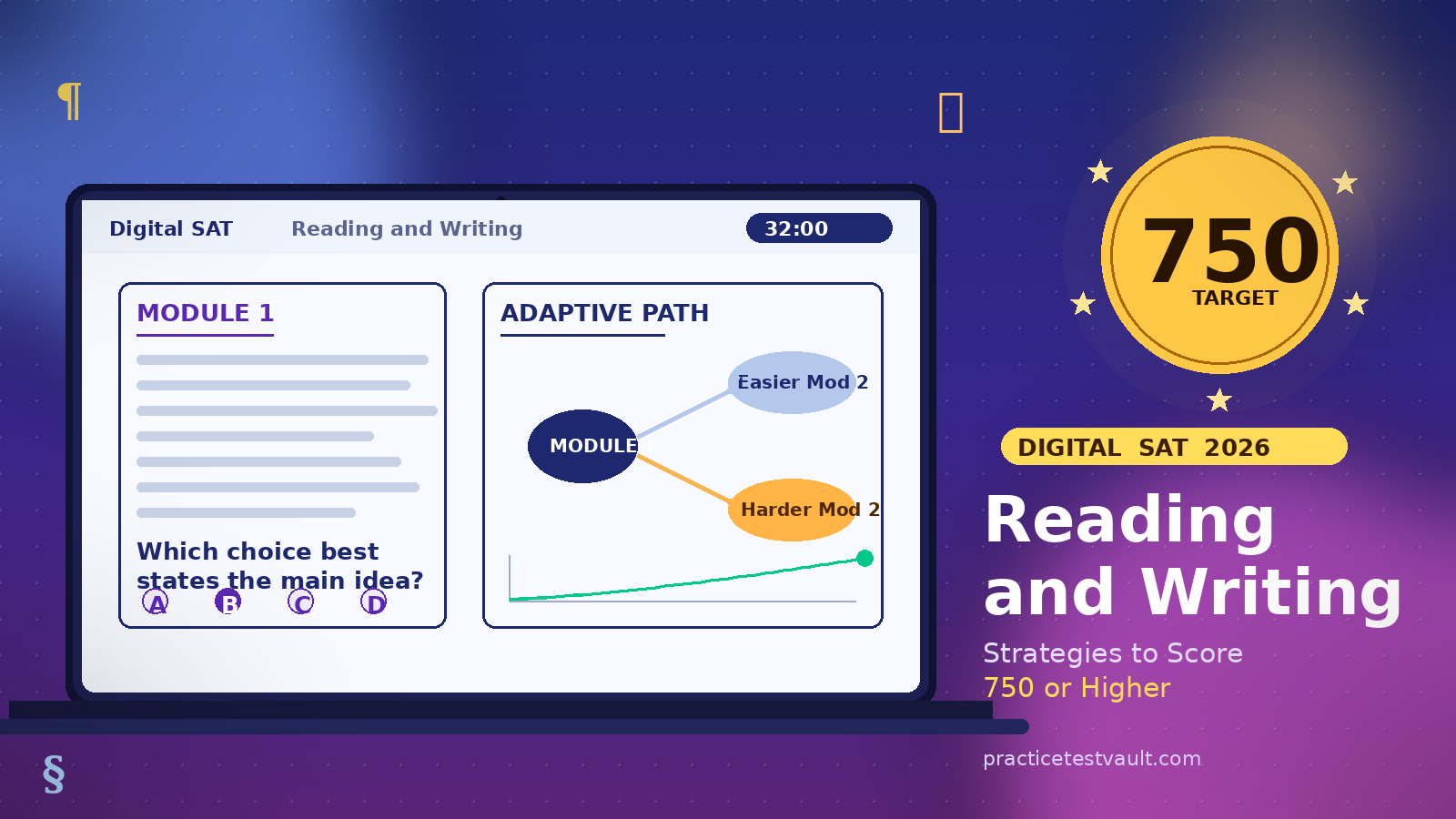
The Digital SAT Reading and Writing section is split into two modules, each 32 minutes long with 27 questions. The test is section adaptive, meaning your performance on Module 1 determines which version of Module 2 you face.
If you perform well on Module 1, you are routed to the harder Module 2, which has a higher score ceiling. If you perform poorly on Module 1, you are routed to the easier Module 2, which caps your maximum possible score. This design has two important implications for strategy.
First, early accuracy matters enormously. Every question in Module 1 counts twice, essentially, because it shapes which Module 2 you see. Students who rush through the first few questions to save time for later often end up in the easier module and lose access to the higher scoring range entirely.
Second, you should not panic if Module 2 feels harder than Module 1. That is a sign you were routed to the higher ceiling module, which is exactly where a 750+ score lives. Seeing easier questions in Module 2 is actually the warning sign, not the reverse.
The Four Content Domains by Weight
The Digital SAT Reading and Writing section tests four domains. Knowing the weighting is essential for deciding where to invest study hours.
Information and Ideas (28% of Score)
This is the largest single domain and your biggest scoring opportunity. Questions ask you to identify main ideas, locate specific details, draw inferences, and interpret data from charts and graphs embedded in passages. The charts and graphs questions are often undertrained by students, even though they are some of the most predictable on the test.
Standard English Conventions (26% of Score)
This is grammar. The good news is that grammar responds faster to targeted study than any other domain. In 4 to 6 weeks of focused work, most students can move from missing 6 to 8 grammar questions per test to missing 1 or fewer. High yield topics: subject verb agreement, verb tense, pronoun case and clarity, modifier placement, punctuation (especially commas, semicolons, and colons), and transitions.
Craft and Structure (28% of Score)
This covers vocabulary in context, text structure and purpose, and cross text connections (where you compare two short passages). The vocabulary questions no longer test obscure words. They test how a familiar word is used in a specific context, which means dictionary study is nearly useless. Read widely and train yourself to infer meaning from surrounding sentences.
Expression of Ideas (20% of Score)
This is the editing and rhetoric domain. Questions include transition word selection, rhetorical synthesis (combining notes into a single sentence that accomplishes a goal), and sentence combining. Rhetorical synthesis is a newer question type that many test takers find tricky because it requires careful attention to the stated goal in the prompt.
Why Module 1 Is Make or Break
We touched on this above, but it deserves its own section because so many students underestimate it. Module 1 is the highest leverage 32 minutes of your entire SAT day.
Think about it this way. If your goal is a 750 Reading and Writing score, you cannot reach that ceiling from the easier Module 2. You must be routed to the harder Module 2, which requires strong Module 1 performance. That means you should train yourself to slow down on the first 10 to 12 questions and confirm every answer with evidence. Save the mild time pressure for the end of Module 1 when you have already locked in the crucial early accuracy.
Practical tactic: for the first 10 questions of Module 1, always do a 5 second sanity check after picking an answer. Ask yourself, “What specific word or phrase in the passage proves this?” If you cannot point to one, revisit the answer choices.
The CORE 4 Method for Every Question
The CORE 4 is a four step workflow that top scorers use on nearly every question, especially Reading and Writing. It stands for Comprehend, Observe, Reason, Execute.
Comprehend: Read the passage once and state its main point in one sentence before looking at the question. This takes 10 to 15 seconds and saves you from getting pulled by attractive wrong answers.
Observe: Read the question stem carefully and identify exactly what it is asking. Is it asking for the main idea? A specific detail? The author’s purpose? The function of an underlined sentence? The question stem tells you what to hunt for.
Reason: Predict your own answer in plain words before looking at the choices. This is the single biggest accuracy boost for most students. If you go to the choices without a prediction, you are vulnerable to wrong answers that sound plausible.
Execute: Match your prediction to an answer choice. If no choice matches, cross out the two you are most confident are wrong and choose the strongest of the remaining two.
Strategy by Question Type
Main Idea Questions
Look for the broadest answer that still fits every sentence of the passage. Wrong answers are usually too narrow (focus on one detail) or too broad (go beyond what the passage actually claims). State the main idea in your own words first, then match.
Vocabulary in Context
Treat these like fill in the blank. Cross out the target word in the passage, read the sentence with a blank, and think of a word that fits. Then match to the answer choices. Never pick based on the word’s most common dictionary meaning because the test loves to use words in their second or third meaning.
Evidence Questions
These ask which choice supports a specific claim. Read the claim carefully, then test each choice by asking “does this choice prove or disprove the claim?” Choices that only weakly relate to the claim are traps.
Data Interpretation
Read the chart or graph first, including axis labels and units. Then read the passage. Then look at which claim the question asks you to support. The right answer will use specific numbers from the chart that match the claim exactly. Wrong answers often cite real data that does not actually support the specific claim.
Rhetorical Synthesis
The prompt always states a goal such as “emphasize a similarity between the two studies” or “introduce the topic to an unfamiliar audience.” Read the goal first, then evaluate each choice by asking “does this sentence accomplish that specific goal?” Many test takers get burned by choosing a grammatically correct sentence that does not actually match the stated rhetorical goal.
Transitions
Classify the logical relationship between the two sentences you are connecting. Is the second sentence adding information (also, moreover), contrasting (however, but), showing cause and effect (therefore, as a result), showing time (then, afterward), or giving an example (for instance)? Pick the transition that matches the relationship. Never pick based on how a transition sounds.
Grammar
Five high yield rules cover most grammar questions. Subject verb agreement (match plural subjects to plural verbs, watch for prepositional phrases that hide the true subject). Verb tense consistency (keep tense aligned across a passage unless the meaning requires a shift). Pronoun clarity (every pronoun needs a clear, singular antecedent). Modifier placement (an opening phrase must modify the noun that immediately follows the comma). Punctuation between independent clauses (use a semicolon, a period, or a comma plus a FANBOYS conjunction).
Top 5 Trap Answer Patterns
Wrong answer choices on the SAT Reading and Writing section follow predictable patterns. Learn to recognize them and you will eliminate 60 to 70% of wrong answers instantly.
Extreme language. Words like always, never, only, entirely, impossible, and the strongest are almost always wrong on inference questions. The test rewards moderate, supportable claims.
Out of scope. The answer introduces an idea that sounds plausible but is not actually in the passage. If you cannot point to the exact words supporting the claim, the answer is probably wrong.
Partially correct. The first half of the answer is right but the second half adds a wrong element. Read every answer all the way through.
Reversed logic. The answer gets the cause and effect backwards, or reverses the relationship between two entities. Always verify direction.
Wrong emphasis. The answer is technically true but mentions a minor point from the passage rather than the main focus. Common in main idea and purpose questions.
12 Week Study Plan
Weeks 1 and 2: Diagnostic and Grammar Foundations
Take a full length official Digital SAT practice test from Bluebook (College Board’s free testing app). Score it, and identify your three weakest question types. Begin daily grammar drills focusing on the five high yield rules. Target 20 grammar questions per day.
Weeks 3 and 4: Information and Ideas Focus
This is your biggest scoring domain. Do 30 passages per day from reputable practice books or online platforms. Focus on main idea, detail, inference, and data interpretation questions. Use the CORE 4 method on every question.
Weeks 5 and 6: Craft and Structure
Drill vocabulary in context, text structure, and cross text connections questions. These are harder to improve quickly but respond to volume and pattern recognition. Read dense non fiction daily (20 to 30 minutes of New Yorker, Atlantic, or science journalism) to build comfort with SAT style prose.
Weeks 7 and 8: Expression of Ideas and Transitions
Rhetorical synthesis and transitions are the most trainable remaining domain. Spend dedicated time here. Create a transition word bank organized by logical relationship and review it daily.
Weeks 9 and 10: Full Length Timed Practice
Take 2 full length tests per week under exam conditions. Review every missed question the same day and categorize the error (content gap, misread, trap answer, time pressure). Adjust your study focus for weeks 11 and 12 based on the pattern.
Week 11: Weakness Targeting
Return to the categorized error log and spend the entire week on the single category where you lose the most points. For most students this will be rhetorical synthesis, cross text connections, or inference.
Week 12: Taper and Test Day Prep
Cut volume in half. Review your notes, do a light mixed practice set daily, and get 8 hours of sleep every night in the final week. Do not take a new full length in the 3 days before test day.
20 Question Practice Diagnostic
Here is a calibrated diagnostic you can use right now. Set a timer for 25 minutes.
Passage 1: “Although the novelist Zadie Smith is best known for her fiction, her essays have earned equal critical praise for their precision and wit.”
The word “precision” most nearly means:
A. strictness
B. exactness
C. measurement
D. severity
Answer: B
Passage 2: “Coral reefs, which cover less than 1 percent of the ocean floor, support nearly 25 percent of all marine species. Their rapid decline due to warming seas threatens not just biodiversity but the livelihoods of millions who depend on reef ecosystems.”
Which choice best states the main idea of the passage?
A. Coral reefs are the most diverse ecosystems on Earth.
B. Coral reef decline has broad ecological and economic consequences.
C. Warming seas are the only threat to coral reefs.
D. One percent of the ocean floor is covered by coral reefs.
Answer: B
(For the remaining 18 questions and full explanations, take our free Digital SAT Reading and Writing practice test linked below.)
Common Mistakes High Scorers Avoid
First, memorizing vocabulary lists. The Digital SAT rewards contextual inference, not rote memorization of obscure words.
Second, reading the question before the passage. Evidence suggests the opposite is more effective. Read the (short) passage first to build a complete picture, then look at the question.
Third, neglecting grammar. Standard English Conventions is 26% of the score and the fastest domain to improve. Students who skip grammar because they “are good at reading” leave 40 to 60 points on the table.
Fourth, rushing Module 1. Early accuracy determines which Module 2 you face. Slow and right beats fast and wrong for the first 10 questions.
Fifth, skipping the Bluebook app. College Board’s official digital testing app is the single best practice tool available. It uses the same interface and adaptive logic as the real exam.
Frequently Asked Questions
How many questions is the Digital SAT Reading and Writing section? Exactly 54 questions, split into two 32 minute modules of 27 questions each.
What is a good Digital SAT Reading and Writing score? A score of 650+ is above the 75th percentile. 700+ puts you in the top 15%. 750+ puts you in the top 5%.
Is the Digital SAT harder than the paper SAT? The Digital SAT is shorter (2 hours 14 minutes total versus 3 hours for paper), uses shorter passages, and adapts to your performance. Most students find it less exhausting but similarly challenging on a per question basis.
How much can I realistically improve in 3 months? Most students who follow a disciplined plan and do 150 to 250 practice questions per week improve by 80 to 150 points across both sections combined.
Can I use Khan Academy instead of paid prep? Khan Academy’s Official Digital SAT Prep is free and solid for foundational work. It pairs well with Bluebook’s full length practice tests. Paid prep tends to offer more personalized feedback and targeted weakness drills.
Do I need to read literature to do well? The Digital SAT uses a mix of literature, history, science, and social science passages. You do not need to read classic novels, but regular exposure to quality non fiction (newspapers, science magazines, historical essays) builds the reading muscles you need.
Final Thoughts
A 750+ Digital SAT Reading and Writing score is built on four pillars: master the five high yield grammar rules, apply the CORE 4 method to every question, nail Module 1 to unlock the harder Module 2, and build stamina through weekly full length timed practice. The students who hit top scores are not naturally gifted readers. They are disciplined test takers who respect the structure of the exam and train systematically.
For more SAT section specific strategies, read our Digital SAT Math tips guide, our PSAT NMSQT complete prep guide, and the Enhanced ACT 2026 guide if you are also considering the ACT. Ready to see where you stand? Take our free Digital SAT Reading and Writing practice test to get your diagnostic score, then dive into our section specific drill packs to target your weakest domains.