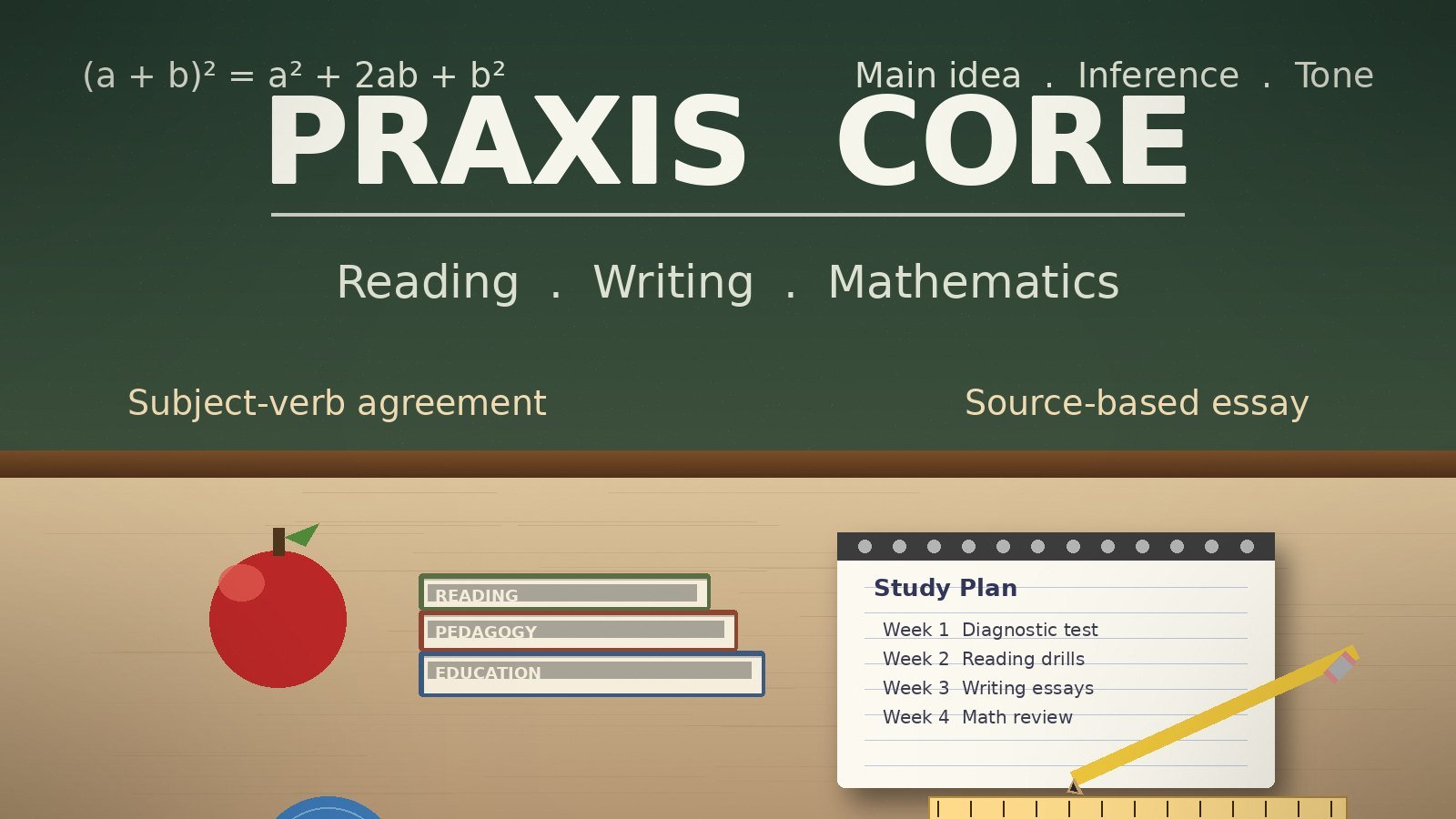
The Praxis Core Academic Skills for Educators is the gateway exam most aspiring teachers must pass before entering a teacher preparation program or earning licensure. The 2026 version tests reading (5713), writing (5723), and mathematics (5733) across three subtests that you can take individually or as the combined Core 5752. This complete guide breaks down the structure, the score requirements by state, the topics you must master, and an 8 week study plan that has is designed to help students pass on the first attempt.
Table of Contents
- What Is the Praxis Core?
- 2026 Praxis Core Exam Format
- Passing Scores by State
- Reading Section Strategy (5713)
- Writing Section Strategy (5723)
- Math Section Strategy (5733)
- Argumentative and Source-Based Essays
- 8 Week Praxis Core Study Plan
- Test Day Tips
- FAQ
What Is the Praxis Core?
The Praxis Core Academic Skills for Educators is administered by ETS and required by most teacher preparation programs and many state departments of education. It measures the academic skills you will be expected to model in your classroom: reading comprehension, written communication, and mathematical reasoning. Most candidates take it during their sophomore or junior year of college, before applying to a school of education.
You can register through the official ETS Praxis website. Each individual subtest costs $90, or you can take the combined Core (5752) for $150 in a single sitting. Tests are delivered at Prometric centers and select universities, with home testing available in most states.
2026 Praxis Core Exam Format
The 2026 Praxis Core has three subtests, each computer delivered.
Reading (5713): 56 selected response questions in 85 minutes. Question types include identifying main ideas, drawing inferences, analyzing author’s purpose, and comparing paired passages. Roughly 35 percent are key ideas and details, 35 percent craft, structure, and language, and 30 percent integration of knowledge and ideas.
Writing (5723): 40 selected response questions in 40 minutes, plus two essays in 60 minutes. The selected response section covers usage, sentence correction, revision in context, and research skills. The two essays are an argumentative essay and a source-based essay.
Mathematics (5733): 56 selected response questions in 90 minutes. Topics include number and quantity (about 30 percent), algebra and functions (about 30 percent), geometry (about 20 percent), and statistics and probability (about 20 percent). An on screen four function calculator is provided.
Passing Scores by State
The Praxis Core uses a scaled score from 100 to 200 for each subtest. The most common required scores are 156 for reading, 162 for writing, and 150 for mathematics, but the bar varies. Some states require lower cuts, others require higher. Check your state’s department of education and the ETS state requirements page before scheduling.
For example, Minnesota requires 156 reading, 162 writing, and 150 math. Pennsylvania requires 156 reading, 162 writing, and 142 math. Texas does not use the Praxis Core for state licensure but many of its teacher preparation programs require it as an admissions screen.
If you do not prepare for your first attempt, you must wait 28 days to retake any subtest. You can retake just the section you missed, which is one major reason to consider taking the subtests on different days when possible.
Reading Section Strategy (5713)
The Praxis Core reading section uses passages of 75 to 200 words, often paired together for comparison questions. Most passages come from social science, history, science, and humanities. None require outside knowledge.
The biggest score boost comes from learning to read for structure first. Before answering any question, identify the main claim, the supporting evidence, and the author’s tone in two or three margin notes. This 30 second investment saves you from re reading the passage for every question.
Three question types account for most missed points. Inference questions ask what is implied but not stated. Stay close to the text. The right answer is rarely a stretch. Vocabulary in context questions ask what a word means in this specific passage. The dictionary definition is often a trap. Choose the meaning that fits the surrounding sentences. Author’s purpose questions ask why the writer wrote the passage. Pay attention to verbs in the answer choices: explain, persuade, illustrate, compare, refute. Each one signals a very different rhetorical move.
Pacing target: 90 seconds per question with three minutes left for review.
Writing Section Strategy (5723)
The 40 selected response questions cover four topics. Usage questions test grammar, agreement, and word choice. Sentence correction questions present a sentence with a flagged section and ask for the best revision. Revision in context questions present a draft essay and ask you to improve specific sentences for clarity, transitions, or evidence. Research skills questions test your ability to evaluate sources, identify proper citations, and recognize plagiarism.
The fastest improvement on the multiple choice writing section comes from drilling subject verb agreement, pronoun reference, parallel structure, and modifier placement. These four topics make up roughly 50 percent of the usage questions.
For research skills, memorize the difference between primary and secondary sources, the basic structure of an APA or MLA citation, and the most common types of plagiarism. ETS reuses similar question stems year over year.
Argumentative and Source-Based Essays
You write two essays in 60 minutes total. Plan to spend 30 minutes on each.
The argumentative essay gives you a claim and asks whether you agree or disagree, with reasons and examples from your own knowledge. Take a clear position in the first sentence. Develop two or three reasons in separate body paragraphs, each anchored by a specific example. Avoid hedging. Graders reward clear stances with strong support over vague balance.
The source-based essay gives you two short passages with opposing or complementary views and asks you to discuss the most important concerns each author raises. Do not pick a side. Summarize each author’s main concerns accurately and evaluate which concerns are best supported. Cite the passages as Source 1 and Source 2 throughout your essay.
Strong essays are 350 to 450 words, organized in four paragraphs (introduction, two body paragraphs, conclusion), and free of major grammar errors. Spelling errors that do not impede meaning will not sink your score, but consistent verb tense, agreement, and clear pronoun reference matter.
Math Section Strategy (5733)
The math section is the subtest most candidates fear, but the content rarely goes beyond pre algebra and basic geometry. The on screen calculator handles most arithmetic, so your prep should focus on setup and reasoning.
Number and quantity covers fractions, decimals, percents, ratios, and basic operations with integers. Master percent change, ratio reasoning, and unit conversions. About 17 questions on test day.
Algebra and functions covers linear equations, simple quadratics, function notation, slope, and inequalities. Know how to solve a system of two equations with two unknowns and how to read a graph. About 17 questions on test day.
Geometry covers area, perimeter, volume, the Pythagorean theorem, properties of triangles and circles, and coordinate geometry. Memorize the area and volume formulas for rectangles, triangles, circles, cylinders, and rectangular prisms. About 11 questions.
Statistics and probability covers mean, median, mode, range, basic probability, and reading data displays. About 11 questions.
Pacing target: 95 seconds per question. Skip and flag any question that takes more than two minutes. The math section rewards momentum more than perfection. For more rigorous quantitative practice that translates well to Praxis Core math, see our GRE Quant strategies.
8 Week Praxis Core Study Plan
Week 1: Diagnostic. Take a full released Praxis Core practice exam under timed conditions. Score it. Identify your weakest subtest. Schedule your test date for week 9 if you have not already.
Week 2: Reading foundations. 30 minutes of reading practice questions every day, 4 days a week. Start a vocabulary log. Review every miss the next morning.
Week 3: Writing usage and revision. Drill 20 multiple choice writing questions per day, 4 days. Begin one timed argumentative essay this week and review against the rubric.
Week 4: Math fundamentals. Review fractions, decimals, percents, ratios, and basic algebra. 25 math questions per day, 4 days.
Week 5: Math advanced. Geometry, statistics, and probability. 25 math questions per day, 4 days. Take a half length math timed quiz on day 5.
Week 6: Essay drilling. One argumentative essay Monday, one source-based essay Wednesday. Score them yourself. Rewrite the weakest paragraph.
Week 7: Full subtest simulations. Take a full timed Reading exam, then a full timed Writing exam, then a full timed Math exam, with a rest day between each.
Week 8: Targeted review and full Combined Core simulation. Take one full Combined Core practice test mid week. Spend the rest of the week shoring up your weakest topic. Two days before the test, taper to light review only.
Take a free Praxis Core practice test to build into your plan.
Test Day Tips
Arrive 30 minutes early with two valid forms of ID. Bring water and a snack for your break. The Praxis Core does not allow scratch paper but provides an erasable note board, so practice writing math work in small, organized chunks during your prep. Use the on screen calculator only when you need it. Reaching for it on every question slows you down.
Pace yourself by section. If you finish reading early, do not waste time triple checking. Use the buffer to refresh before writing or math. The mental tax of a five hour testing window is real.
Frequently Asked Questions
How long are Praxis Core scores valid? Praxis Core scores remain valid for 10 years from the date you took the test. Most state licensure offices and teacher preparation programs honor scores within that window.
Can I take the Praxis Core subtests on different days? Yes. Many candidates space them out by two to four weeks to focus their preparation on one subject at a time.
How long does it take to get my Praxis Core scores? Selected response scores are available unofficially right after the test. Official scores, including essay scores, are reported about two weeks after your test date.
Is the Praxis Core hard? The content is roughly high school level, but the timing pressure and multi subject nature make it challenging without preparation. About 60 to 70 percent of test takers pass each subtest on the first attempt.
Do I need to take the Praxis Core if I have an SAT or ACT score? Some states accept SAT, ACT, or GRE scores in lieu of the Praxis Core if your scores meet the state minimum. Check your state’s department of education to confirm.
Can I retake just one subtest? Yes. You can retake any individual subtest after a 28 day wait. You only pay the fee for the subtest you retake.
Start Your Praxis Core Prep Today
The Praxis Core is one of the most beatable certification exams when you prepare with the right strategy. Use this guide to build your 8 week plan, focus your time on the weakest subtest first, and rehearse under timed conditions. Take our free Praxis Core practice test to set your baseline today, and pair it with our TEAS test guide if you are also pursuing nursing school admissions.
Independent study note: This article is educational exam-prep guidance only. It is not official exam-owner material and does not guarantee any score, license, certification, admission, scholarship, job, or passing outcome.