PracticeTestVault

MCAT 2026 Study Plan: How to Score 520 Plus and Get Into a Top Medical School

MCAT 2026 Study Plan: How to Score 520 Plus and Get Into a Top Medical School

A 520 on the MCAT is the score that separates good applicants from competitive ones at top tier medical schools. It puts you in roughly the 97th percentile, which means about 3 out of 100 test takers score higher and 97 score lower. Schools like Johns Hopkins, Stanford, Harvard, and the rest of the top 20 see plenty of 520 plus applicants every cycle, and admissions committees increasingly look at how your MCAT score lines up with your science GPA. If you want a real shot at those programs, a 520 is the target.

This guide is the full playbook. It covers what the MCAT actually tests in 2026, how the four sections weigh into your total score, how to build a six month study plan, how to attack each section, and the specific habits that move someone from a 510 plateau to a 520 plus score. Read it once for the big picture, then come back and use the week by week plan as your map.

Take a free MCAT section practice test when you finish reading so you know your starting point before you build your plan.

Table of Contents

  • What the MCAT covers in 2026
  • How MCAT scoring works
  • What a 520 plus score requires
  • Six month MCAT study plan
  • Chemistry and Physics strategies
  • CARS strategies
  • Biology and Biochemistry strategies
  • Psychology and Sociology strategies
  • Full length exams and timing
  • Common reasons 510 students stall
  • FAQ

What the MCAT Covers in 2026

The MCAT is a 7 hour and 30 minute exam administered by the AAMC. It has four scored sections. Chemical and Physical Foundations of Biological Systems, often shortened to Chem and Phys or C and P, has 59 questions in 95 minutes. Critical Analysis and Reasoning Skills, known as CARS, has 53 questions in 90 minutes. Biological and Biochemical Foundations of Living Systems, often called Bio and Biochem or B and B, has 59 questions in 95 minutes. Psychological, Social, and Biological Foundations of Behavior, known as Psych and Soc or P and S, has 59 questions in 95 minutes.

Each section is built around passages with several questions attached. Some questions are passage based and require you to read carefully, integrate the passage with your background knowledge, and infer answers. Other questions are discrete and ask about a fact directly. The MCAT in 2026 leans heavily on integrative reasoning. You are expected to combine two or three concepts to reach a conclusion, not just recall one fact.

Content categories include general chemistry, organic chemistry, physics, biochemistry, molecular biology, cell biology, physiology, behavioral psychology, social psychology, sociology, statistics, and research design. Knowing the catalog of topics is step one of planning your study.

How MCAT Scoring Works

Each section is scaled from 118 to 132. Your total score is the sum of the four sections, ranging from 472 to 528. The mean score is around 500 and the median is similar. A 520 means you scored about 130 per section on average. A 524 means 131 per section. The scoring scale is designed so that small differences in raw score can produce one or two point differences in scaled score, which is why precision in your practice review pays off.

Percentile rankings shift slightly each year as the AAMC re scales, but 520 has remained at or near the 97th percentile for several years. A 515 sits around the 91st percentile, and a 510 is around the 79th percentile. The jump from 510 to 520 is the biggest practical gain you can make for medical school admissions, since most top programs see their admit class median land between 519 and 523.

What a 520 Plus Score Requires

Hitting 520 plus comes down to three things. First, you need command over the AAMC content outline. Most students who plateau below 515 still have gaps in physics, organic chemistry mechanisms, or biostatistics that show up under timed pressure. Second, you need passage stamina, which is the ability to read 8 to 10 dense passages per section without losing focus. Third, you need clean test execution. That means correct pacing, smart guessing, and a calm head when you hit a question you do not recognize.

A useful section breakdown for a 520 looks like this. Aim for a 130 in Chem and Phys, a 129 in CARS, a 131 in Bio and Biochem, and a 131 in Psych and Soc. CARS is the hardest section to push above 130 for non native English speakers and STEM heavy students, so most strategies trade slightly higher science scores for a steady CARS score.

Six Month MCAT Study Plan

Six months is the most common timeline for a 520 plus goal. If you have more time, the same structure works with longer review weeks. If you have less, you can compress it but expect to study 30 to 40 hours per week.

Month 1: Diagnostic and Content Foundation

Begin by taking the AAMC official free sample test. Do not score chase. The point is to identify gaps. Then start a content review phase. Spend three to four weeks rebuilding general chemistry, physics, and biochemistry fundamentals. Use a structured resource like Kaplan, Princeton Review, Blueprint, or Khan Academy. Add active recall flashcards from day one. Anki decks aligned to the AAMC outline save hundreds of hours over self made decks.

Month 2: Content Depth

Finish content review with organic chemistry, biology, psychology, and sociology. Start CARS practice with three passages per day, every day. Do not score them in your head. Time each passage, then review carefully. CARS is a reading habit, not a content area, and consistent daily reps beat large weekend sessions.

Month 3: Section Banks and Practice Passages

Now move into the AAMC Section Banks and third party question banks like UWorld and AAMC Question Pack. Do 40 to 60 questions per day across all sections. Maintain a mistake journal. For every wrong answer, write down the content gap, the trap pattern, and the rule you will apply next time.

Month 4: First Full Length Cycles

Take your first AAMC full length exam, AAMC FL1, under real test conditions. Score it. Block out an entire day for review, ideally two days. Continue daily CARS and start mixing in question bank work focused on your two weakest content categories. Take AAMC FL2 toward the end of the month.

Month 5: Heavy Full Length Phase

Take one AAMC full length exam each week. Use AAMC FL3, FL4, and FL5, then revisit any FL with significant unfamiliar material. The goal is to score within 2 points of your target on at least three full lengths before test day. Review takes longer than the test itself. A 7 hour and 30 minute test should be paired with at least 10 to 14 hours of review.

Month 6: Taper and Test Day Prep

Reduce content review and focus on consolidation. Take one more full length two weeks out, then a final one 7 to 10 days out. Spend the last week reviewing your mistake journal, sleeping 8 to 9 hours per night, and simulating your test day schedule. Do not cram in the final 48 hours. Cramming has been shown to lower performance because it crowds out short term memory consolidation.

Chemistry and Physics Strategies

The Chem and Phys section rewards strong fundamentals and quick equation manipulation. Memorize the 30 most common equations and their units. You should be able to write the ideal gas law, Bernoulli, Coulomb, the lens equation, and basic thermodynamics from memory in under a minute. Memorize common reduction potentials, common pKa values, and rate law forms.

For passage based questions, scan the passage for figures and tables first. Many Chem and Phys passages give you all the data you need without making you read every sentence. Use the figures to anchor your understanding, then go back and read where needed.

Discrete questions in Chem and Phys are often easier than passage questions. Make sure you do not lose points there. Practice with both AAMC and third party material to expose yourself to a range of question styles.

CARS Strategies

CARS does not test content. It tests how carefully and quickly you read. The 520 plus mindset for CARS is to treat each passage like an argument map. As you read, note the main claim, the supporting points, and any counterclaims. You do not need to understand every sentence. You need to understand the structure of the argument.

Train yourself to read at one consistent speed. Skimming kills CARS scores because you miss the nuance that distinguishes the correct answer from the trap. Slow reading also kills scores because you run out of time. Find your sustainable pace and practice at it daily.

For inference and analogy questions, decide what you think the answer should be before reading the choices. Then match your prediction. This stops you from being swayed by attractive distractors written to feel correct.

Biology and Biochemistry Strategies

Bio and Biochem is the most content heavy section. The AAMC tests metabolism, enzyme kinetics, molecular biology, and physiology heavily. Memorize the major metabolic pathways, including glycolysis, the citric acid cycle, oxidative phosphorylation, the urea cycle, and fatty acid oxidation. Know the regulatory enzymes, the ATP and NADH yields, and the major substrates and products.

Many Bio and Biochem passages present a research experiment with figures showing protein expression, enzyme activity, or cell behavior. Practice reading scientific figures every week. The skill of interpreting a Western blot, a gel electrophoresis result, or a Michaelis Menten plot quickly is what unlocks the high score.

Psychology and Sociology Strategies

Psych and Soc is the most efficient section to push toward a 131 or 132. The content is finite and largely fact based. Use Khan Academy videos, the 86 page Khan Academy outline, and Anki decks built from the AAMC content outline. Spend one focused week memorizing terms, theorists, and concepts. Then do question banks until you can identify the term being tested in under 10 seconds.

Watch for vocabulary tricks. The MCAT often tests whether you can tell apart two similar terms, like assimilation versus accommodation, or stereotype threat versus self fulfilling prophecy. Build flashcards that pit similar terms against each other so you train the discrimination directly.

Full Length Exams and Timing

The AAMC publishes five full length scored practice exams plus a sample test. Treat these as the gold standard. Take all six during your prep. Third party full lengths from Blueprint, Altius, Jack Westin, and others are useful for stamina but tend to be harder than the real test in some sections and easier in others. Use them for practice but do not draw conclusions about your real score from them.

Timing benchmarks for a 520 plus score look like this. In Chem and Phys, aim for about 8 to 9 minutes per passage. In CARS, aim for about 9 to 10 minutes per passage including questions. In Bio and Biochem, aim for about 9 minutes per passage. In Psych and Soc, aim for about 9 minutes per passage. Discrete questions should average 60 to 75 seconds each.

Common Reasons 510 Students Stall

Most students who plateau at 510 share three habits. They take many full lengths but review them superficially. They skip CARS daily practice because they tell themselves it is a content free section. They study passively by re reading notes instead of actively retrieving information from memory. Fix those three habits and your score moves.

One more pattern worth noting. Many students burn out in month four or five because they do not protect their sleep, exercise, and rest days. The MCAT is a marathon, and a tired brain forgets the very content it studied. Protect your sleep and you will outscore tired competitors on test day.

Frequently Asked Questions

How many hours should I study for the MCAT to score 520?

Most 520 plus scorers put in 350 to 500 total hours of focused study. Spread across six months at 15 hours per week, that lands around 390 hours, which is a reasonable target.

Are AAMC materials enough on their own?

AAMC materials are essential and the most predictive, but most students need a third party question bank like UWorld or Blueprint for volume. The AAMC Section Banks are smaller than what you need for full coverage.

When should I take the MCAT?

Most premed students take the MCAT in the spring or summer of their junior year so they can apply to medical school the following cycle. If you are a non traditional applicant or career changer, choose a test date that allows you at least 4 to 6 months of dedicated prep.

Is the MCAT harder in 2026 than in past years?

The AAMC has not announced major content changes for 2026, but admissions committees increasingly value MCAT performance that demonstrates clinical reasoning. The test feels harder to students who memorize facts rather than connect concepts.

Can I retake the MCAT if I score below 520?

You can take the MCAT up to three times in one calendar year, four times across two years, and seven times in your lifetime. Most schools accept your highest score, but some look at all attempts. Retaking is worth it if you have time to address the specific reasons you fell short.

Your Next Step

The path to a 520 plus is long but the steps are clear. Start by finding your baseline today. Take a free MCAT practice test on PracticeTestVault and use your results to anchor month one of the plan above. Track your progress every week, review carefully, and trust the process. Medical schools see the score, but admissions committees notice the discipline behind it.
PracticeTestVault

MCAT 2026 Complete 6 Month Study Plan: How to Aim for 515+

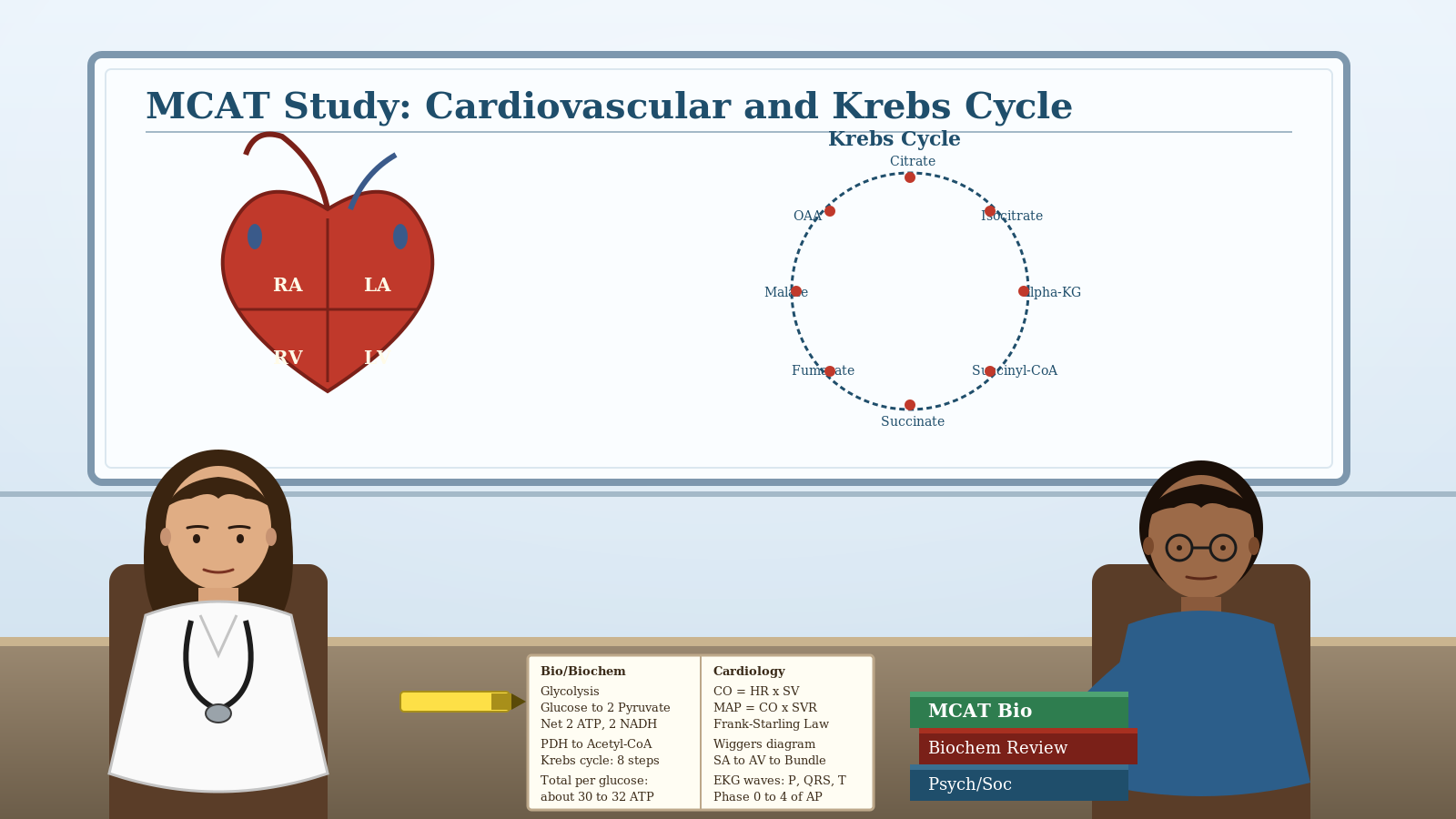
Premed students studying MCAT cardiovascular and Krebs cycle
MCAT prep done right: collaborative review of cardiovascular physiology and the Krebs cycle.

The MCAT in 2026 still costs more time than any other admissions exam in the United States. The test runs about 7 hours and 30 minutes including breaks, asks 230 questions across four scored sections, and demands recall of more than 80 high yield topics from biology, chemistry, biochemistry, physics, psychology, and sociology. Add the famously challenging CARS section and the test starts to feel impossible to plan for. It is not. With a structured 6 month study plan, the right resources, and consistent practice scoring habits, a 515 plus score is realistic for most candidates who finished their prerequisite coursework.

This guide gives you a complete week by week MCAT study plan for 2026, the highest yield content topics for each section, the schedule that produces 510 plus scores most often, and a final 6 week sprint that fixes weak areas and pushes a borderline 510 into a 515 or higher.

Table of Contents

2026 MCAT Format and Scoring

The MCAT has four scored sections, each scored from 118 to 132 with a midpoint of 125. The total score ranges from 472 to 528 with a midpoint of 500.

Chemical and Physical Foundations of Biological Systems contains 59 questions in 95 minutes. Roughly 25 percent biochemistry, 30 percent general chemistry, 25 percent physics, and 5 percent organic chemistry, with biology playing a small role.

Critical Analysis and Reasoning Skills (CARS) contains 53 questions in 90 minutes. Nine passages from humanities and social sciences. No outside knowledge. The most predictive section for medical school success and the most resistant to short term improvement.

Biological and Biochemical Foundations of Living Systems contains 59 questions in 95 minutes. Roughly 65 percent biology, 25 percent biochemistry, 5 percent organic chemistry, 5 percent general chemistry.

Psychological, Social, and Biological Foundations of Behavior contains 59 questions in 95 minutes. Roughly 60 percent psychology, 30 percent sociology, 10 percent biology. The most content heavy section relative to depth.

The 90th percentile sits at about 515. The median accepted MD applicant scored a 511 to 512 in the last cycle. The median DO accepted applicant scored about 504. Set your goal based on the schools you want to apply to, then add 2 to 3 points as a safety buffer because score variance on practice tests is real.

Diagnostic Test and Score Targets

Take a free diagnostic test before you start studying. The AAMC offers a free Sample Test and the Princeton Review offers a free full length. Use the score breakdown to decide your time allocation. If your weakest section is more than 4 points below your average, that section gets 40 percent of your study time for the first 8 weeks.

Set three score targets: a floor (the minimum you would be happy with), a goal (your realistic target based on diagnostic plus 12 to 18 points of growth), and a stretch (your goal plus 3 points). Most students gain about 1 point per 30 hours of focused study, with diminishing returns after a 515.

Resources That Actually Move the Score

The MCAT prep market is crowded. Almost every score above 515 comes from the same short list of resources used in combination.

Content review: Kaplan books for breadth, Khan Academy MCAT videos for free deep dives on tricky topics like circuits and kinematics, and Mr. Pankow or AK Lectures on YouTube for visual learners.

Question banks: AAMC question packs and Section Banks (the most representative questions you will ever see), UWorld for MCAT (the gold standard for explanations and difficulty calibration), and Jack Westin for free CARS daily passages.

Full length practice exams: The four AAMC full length exams, three Blueprint MCAT full lengths, and one or two Altius full lengths. Save the AAMC official tests for the final 6 weeks.

Anki: The Miledown deck and the Pankow Anki deck are the two most used decks among 515 plus scorers. Aim for 200 to 300 reviews per day during content review and taper to 100 per day in the final month.

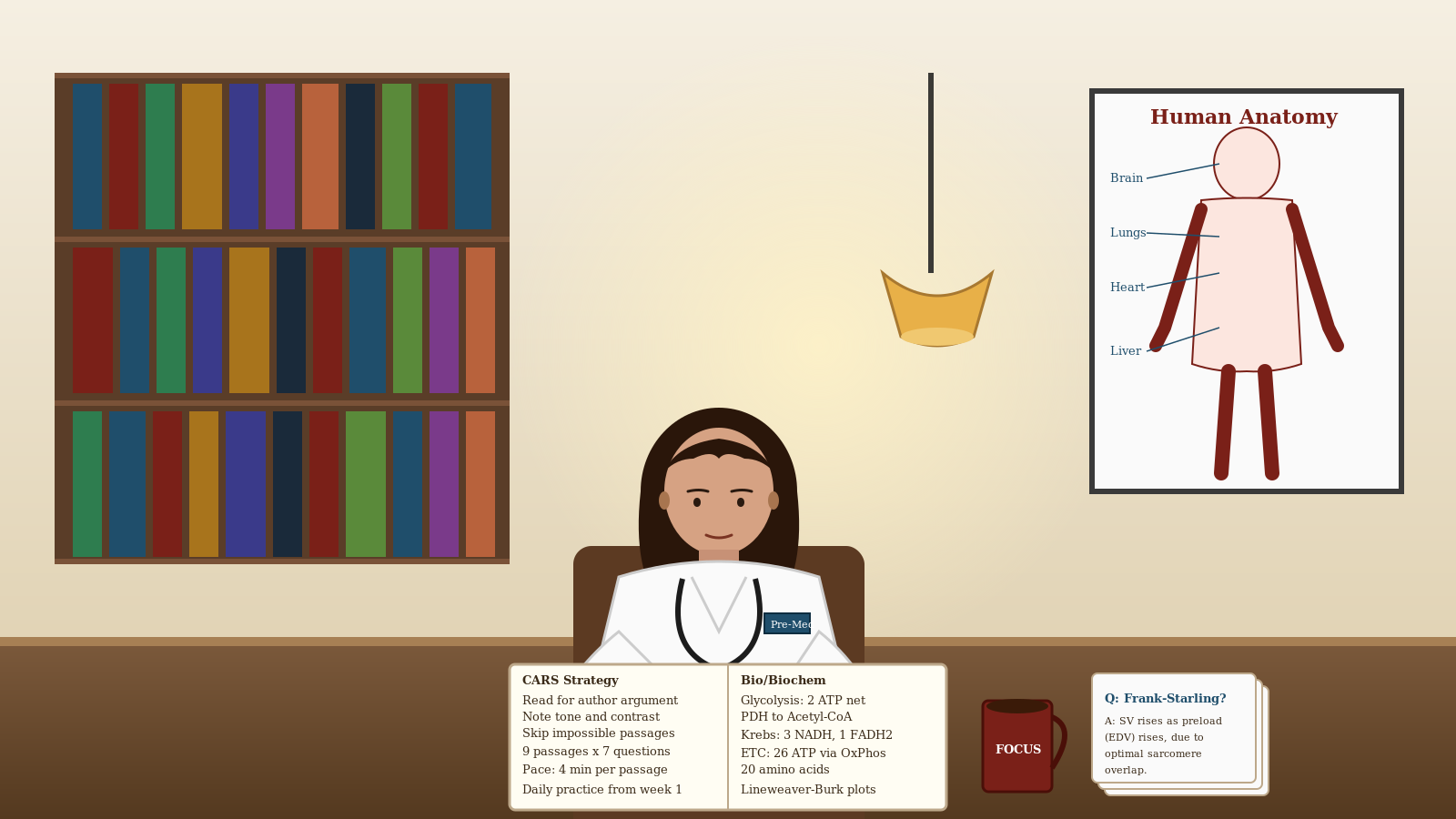
Premed student studying MCAT with anatomy poster and flashcards
Daily Anki reviews and a quiet study space build the consistency that separates 510 from 515 plus.

6 Month MCAT Study Plan Week by Week

This plan is built around 25 to 30 hours of study per week. Pre med students balancing classes can spread it over 8 months at 18 hours per week with similar results.

Month 1: Content Foundations. Read the Kaplan biochemistry, biology, and general chemistry books. Watch Khan Academy videos for any topic you do not understand on the first read. Start the Miledown Anki deck on day one and never miss a day of reviews. End the month by taking the AAMC Sample Test as a content checkpoint, not a true full length.

Month 2: Content and Light Practice. Read the Kaplan organic chemistry, physics, and behavioral sciences books. Begin UWorld at 30 questions per day in tutored mode. Start Jack Westin daily CARS passages, one per day, untimed at first.

Month 3: Practice Heavy. Finish Kaplan content review by week 9. Increase UWorld to 60 questions per day across mixed sections. Begin AAMC question packs (Bio, Chem, Phys). Take a Blueprint full length at the end of the month for a baseline score.

Month 4: AAMC Material Begins. Start the AAMC Section Banks (these are the most representative questions in existence). Continue UWorld at 60 per day. CARS becomes daily timed practice with two passages per day. Take a second Blueprint full length at the end of the month.

Month 5: Full Length Heavy Month. Take one full length per week, alternating Blueprint and AAMC. Spend the day after each full length doing a deep review for 4 to 6 hours. Categorize every wrong answer by reason: content gap, careless error, misread question, or pacing. This single habit is what moves a 510 to a 515.

Month 6: AAMC Only Sprint. AAMC full length exams 1 through 4 across the first three weeks, plus all AAMC question packs and Section Banks finished. The final week is light: review your mistake log, redo only the questions you got wrong, sleep 8 hours per night, and take 2 days completely off before test day.

CARS Approach and Pacing

CARS is the section that most resists short term gains, but it is also the section most predictive of medical school performance. The key is daily practice from week 1, not a content cram in the final month.

Read each passage in 4 minutes or less. Keep a mental highlight on the author’s argument, tone, and any contrast words. Skip passages that feel impossible on the first read and return at the end. Most students who score 128 plus on CARS spend less time per question than the average test taker, which counterintuitively means they slow down on the passage and speed up on the questions.

For deeper CARS specific tactics, see our MCAT CARS Strategies 2026 guide.

Section by Section Strategy

Chemical and Physical (Chem Phys): The hardest section for most non engineers. Memorize the 30 most tested equations on a single index card and review it weekly. Most physics questions reduce to one of five setups: kinematics, work and energy, fluids, optics, or circuits. Practice unit analysis on every problem.

CARS: See above. Daily practice from day one is non negotiable.

Biological and Biochemical (Bio BC): Highest scoring section for most students because it leans heavy on memorization plus passage interpretation. Master the 20 metabolic pathways and the 20 amino acid structures. Know enzyme kinetics, especially Lineweaver Burk plots and inhibition types, cold.

Psychological and Social (Psych Soc): The 86 page Khan Academy 300 page document (the Mr. Pankow document) is the single most cited resource for 130 plus on this section. Read it twice in months 4 and 5. Anki everything that has a name attached: theory, syndrome, researcher, study, drug class.

Full Length Test Schedule

Take 8 to 10 full length practice tests before your real exam. The order matters because AAMC tests are the most representative.

Months 3 and 4: 1 Blueprint, 1 Altius, 1 Blueprint. These build endurance and surface content gaps without burning your AAMC stock.

Month 5: 1 Blueprint, 1 AAMC FL1, 1 AAMC FL2, 1 Blueprint. Now you are simulating real exam conditions.

Month 6: AAMC FL3, AAMC FL4, AAMC Sample Test (rescored). The AAMC tests are your most accurate score predictors. Take them under exact test day conditions, including the same wake up time and the same breakfast.

Test Day Plan

Lay out your bag the night before: confirmation email, two forms of ID, snacks, water, lip balm, ear plugs (allowed in most centers), light layers. Arrive 30 minutes early. Use the optional 10 minute breaks for fuel and bathroom only, not last minute review.

During the test, never spend more than 90 seconds on a single question. Mark and move. The test penalizes pacing far more than it rewards a single hard question solved. If you finish a section with time, return only to flagged questions, not to second guess answers you were confident in.

Frequently Asked Questions

How long should I study for the MCAT? Most successful students study for 4 to 6 months at 25 to 30 hours per week. Total study time around 500 to 700 hours produces the most consistent 510 plus scores.

What is a good MCAT score for medical school? A 510 puts you at roughly the 80th percentile and is competitive for most MD programs. A 515 puts you at the 90th percentile and is competitive for top 30 MD programs. A 504 is the median for accepted DO students.

How many practice tests should I take for the MCAT? Take 8 to 10 full length practice tests, including all 4 AAMC official full lengths. Save the AAMC tests for the final 6 weeks because they are the most predictive.

Can I improve my MCAT score by 10 points? Yes, with 200 plus hours of focused study and consistent full length practice. The improvement curve flattens after a 515, so going from 505 to 515 is far more common than going from 515 to 525.

When should I take the MCAT? Take it after finishing prerequisite coursework: general chemistry, organic chemistry, biology, physics, biochemistry, psychology, and sociology. Most applicants take the exam in the spring or early summer of their application year (April through June for a same year application cycle).

Is the MCAT harder than the SAT or ACT? Yes. The MCAT covers more content, requires deeper reasoning, and lasts more than twice as long as the SAT. It is closer to the LSAT or USMLE Step 1 in difficulty.

What is the best free MCAT practice test? The AAMC Sample Test is free and the most representative free option. Princeton Review and Blueprint also offer free full lengths. For shorter practice, our free MCAT practice questions let you drill specific topics with instant explanations.

Take a Free MCAT Practice Test

Want to see where you stand right now? Take our free MCAT practice test with timed sections and detailed score reports. You will get a section by section breakdown, a recommended study focus, and a list of next steps based on your weakest topics. Pair the practice test with our USMLE Step 1 study plan if you want to plan ahead for medical school exams as well.

PracticeTestVault

MCAT CARS Strategies 2026: How to Master the Critical Analysis and Reasoning Skills Section

The MCAT Critical Analysis and Reasoning Skills section, known universally as CARS, is the one part of the exam you cannot out-memorize. While other sections reward you for years of studying biology, chemistry, biochemistry, physics, psychology, and sociology, CARS rewards clear thinking. It is the great equalizer, and it is also the section that breaks the most pre-meds.

The good news is that CARS is absolutely learnable. Students who treat it as a strategy section, not a content section, routinely raise their scores by 3 to 5 points over a few months of intentional practice. This guide lays out a practical way to approach how top scorers approach CARS passages, the habits that separate a 125 from a 130, and a study plan you can run during a full MCAT cycle.

Want to put these techniques to work right now? Take our free MCAT-style practice passages and apply every strategy below under realistic timed conditions.

Table of Contents

  • What the CARS Section Tests
  • The CARS Format and Timing
  • Why CARS Is Different From Every Other Section
  • The 3 Skill Types CARS Measures
  • 9 practical CARS Strategies From High Scorers
  • How to Read a CARS Passage Actively
  • The Question Type Playbook
  • Time Management for a 90-Minute Marathon
  • How to Review CARS Passages
  • Building Reading Stamina
  • A 12-Week CARS Study Plan
  • Common Mistakes to Avoid
  • Frequently Asked Questions

What the CARS Section Tests

CARS is the only MCAT section that requires zero outside content knowledge. Every piece of information you need is provided in the passages. The AAMC intentionally chooses topics from the humanities and social sciences, such as philosophy, ethics, literature, art history, political theory, and cultural studies, so no single pre-med background has an advantage.

That structure is deliberate. Medical schools want physicians who can read a complex, unfamiliar text, extract the main argument, evaluate its logic, and apply its reasoning to new situations. Those are clinical thinking skills in disguise, and CARS is the proxy medical schools trust to measure them.

The CARS Format and Timing

The CARS section gives you 90 minutes to work through 9 passages and 53 questions. Each passage is 500 to 600 words, followed by 5 to 7 questions. That works out to roughly 10 minutes per passage, including reading and answering. The AAMC explicitly scores CARS from 118 to 132, with 125 as the median.

There are no experimental passages on CARS. Every single question counts. That pressure is real, and building a repeatable process is the only way to consistently finish the section with all 53 answers bubbled and most of them correct.

Why CARS Is Different From Every Other Section

Most pre-meds are trained to study by memorizing facts. That approach fails in CARS. You cannot flashcard your way to a 130. What works is a systematic reading process and deep question-type familiarity, both built through daily practice over months.

CARS also punishes outside knowledge. If the passage says something that contradicts what you learned in class, the passage wins every time. Trust only the text. A choice that is factually accurate but not supported by the passage is always wrong.

The 3 Skill Types CARS Measures

Foundations of Comprehension

About 30 percent of CARS questions test basic comprehension. These ask you to identify the main idea, a specific detail, or the meaning of a word in context. Treat them as accuracy checkpoints, because losing points on comprehension is a warning sign you are rushing your reading.

Reasoning Within the Text

Another 30 percent of questions ask you to evaluate the author’s argument, identify unstated assumptions, or assess the logical structure of the passage. This is where most pre-meds lose points, because it requires active critical reading rather than passive absorption.

Reasoning Beyond the Text

The remaining 40 percent of questions ask you to apply passage reasoning to new situations, or to evaluate how new information affects the argument. These are the hardest questions and the biggest differentiator between a 127 and a 131. Master them, and your score climbs.

9 practical CARS Strategies From High Scorers

Strategy 1: Read for Structure, Not Detail

Your first read should map the passage’s structure. What is the thesis? How does each paragraph support or challenge it? Where does the author’s voice appear? Details you can always find by scrolling back. Structure is the scaffolding that lets you answer almost any question quickly.

Strategy 2: Identify the Author’s Main Point and Attitude

Every CARS passage has a central claim. Before you open the questions, you should be able to state that claim in one sentence. You should also know the author’s attitude: skeptical, enthusiastic, neutral, critical, ambivalent. Nearly every question will trace back to that attitude.

Strategy 3: Use the 80-Second Rule

Each question should take 60 to 90 seconds. If you cross 90, make your best guess, flag it, and move on. Staring at a question rarely produces insight. Moving on protects your accuracy on the easier questions that follow.

Strategy 4: Keep Outside Knowledge Outside

If a choice sounds right because you remember it from another class, that is a warning sign. The only evidence that matters is in the passage. Ask yourself which specific sentence supports the choice. If you cannot point to one, eliminate it.

Strategy 5: Predict Before You Peek

After reading the question stem, form a quick mental prediction before scanning the answer choices. This simple habit shields you from trap answers that sound right until you pick them apart.

Strategy 6: Eliminate Aggressively

In CARS, there are always two strong contenders and two easy eliminations. Your first job is to cut the easy ones fast. Then compare the remaining two closely. Usually one has a subtle flaw: an extreme word, a new idea not in the passage, or the wrong scope.

Strategy 7: Watch for Extreme Language

Words like “always,” “never,” “all,” “none,” “must,” and “only” almost always kill an answer choice unless the passage itself uses that extreme language. The AAMC favors hedged, carefully qualified answers that mirror the passage’s own tone.

Strategy 8: Recognize and Neutralize Trap Patterns

Trap answers fall into a few consistent types: out-of-scope choices that introduce new ideas, half-right choices that include a correct claim plus a wrong one, reversed choices that flip the author’s view, and extreme choices that overstate a moderate claim. Naming the trap as you eliminate it trains your brain to spot them faster.

Strategy 9: Build a Daily CARS Habit

One CARS passage per day for three months will do more for your score than any single weekend cram session. Consistent daily reps build pattern recognition that no last-minute prep can replicate.

How to Read a CARS Passage Actively

Active reading is the foundation of every CARS strategy. Start by reading the first sentence of each paragraph slowly. These topic sentences usually reveal the passage’s structure. Then skim the middle and read the last sentence carefully. End-of-paragraph sentences often contain the author’s moves, such as concessions, transitions, and conclusions.

As you read, mentally tag each paragraph with a role: setup, evidence, counterargument, rebuttal, synthesis, conclusion. That mental map makes question attacks much faster. Also watch for author signal words. Phrases like “however,” “nevertheless,” “in contrast,” and “surprisingly” flag shifts in argument, and shifts are where questions love to hunt.

Do not get stuck on unfamiliar vocabulary. Infer meaning from context and keep moving. You have 10 minutes per passage, and you cannot afford to lose 90 seconds parsing a single sentence about 18th-century aesthetic theory.

The Question Type Playbook

Main Idea and Tone Questions

These ask for the central claim or the author’s attitude. The correct answer reflects both the scope and the tone of the passage. If the passage is mildly critical, the correct choice will be mildly critical, not wildly dismissive.

Detail Questions

Detail questions ask about specific sentences or concepts. Return to the passage for these. Your memory is not reliable enough, and the trap answers are designed to sound correct to someone relying on recall.

Inference Questions

Inference questions ask what follows from the passage without being explicitly stated. The correct answer is usually a conservative step. If a choice requires you to fill in a big assumption, it is probably wrong.

Application Questions

Application questions give you a new scenario and ask which choice the author would agree with, or how the scenario illustrates the author’s argument. Anchor yourself to the author’s main point, then test each choice against that point.

Strengthen and Weaken Questions

These ask which choice most supports or undermines the author’s argument. Identify the claim under attack, then look for a choice that either adds a missing piece of support or introduces a direct counterexample.

New Information Questions

These questions introduce a new fact and ask how it affects the passage. Classify the new fact quickly: does it support, contradict, or complicate the author’s position? Then select the choice that matches your classification.

Time Management for a 90-Minute Marathon

Ninety minutes of intense reading is exhausting. Set checkpoints every 30 minutes. After the first 30 minutes, you should be on passage 4. After 60 minutes, you should be on passage 7. If you fall behind, speed up by skimming the next passage, not by rushing questions. Rushed questions hemorrhage points.

Flag and return. If a question is taking too long, mark your best guess, flag it, and return at the end. You will finish the section with all 53 answers in place, and flagged questions often become obvious once your head is clear.

How to Review CARS Passages

Review is where scores are built. For every missed question, write a sentence explaining why the correct answer is right and why your chosen answer is wrong. Then write a sentence explaining what in your process led to the miss. Over time, those sentences reveal consistent weaknesses, and those weaknesses become your next drilling priorities.

Review correct answers too, especially the ones you got right through lucky guesses. A correct answer with shaky reasoning is a liability on test day. Only answers you fully understand belong in the “mastered” column.

Building Reading Stamina

CARS is as much a stamina test as a reasoning test. Build your reading muscles by spending 30 minutes a day on dense non-fiction. The Atlantic, The New Yorker, Aeon, and academic journals are all excellent. Focus on texts that force you to think, not ones that entertain you passively.

When you read, practice the same habits you use on CARS passages. Identify the thesis, tag paragraph roles, note the author’s tone. The more automatic these habits become, the less energy they cost you on test day.

A 12-Week CARS Study Plan

Weeks 1 through 3 focus on fundamentals. Do one untimed passage per day. Read slowly, answer deliberately, and review thoroughly. The goal is not speed. The goal is to build an accurate process.

Weeks 4 through 6 introduce timed passages. Start doing two passages per day at timed pace. Review every miss and every slow question. Your baseline for passage completion should drop from 12 minutes to 10 minutes across these weeks.

Weeks 7 through 9 focus on full sections. Do one full 9-passage CARS section every other day. This is where endurance is built. Review each section for 90 minutes afterward, the same amount of time it took to complete.

Weeks 10 through 12 integrate CARS into full-length practice tests. Take a full MCAT every week, treating CARS as the anchor section that sets the tone. By the end of week 12, your CARS score should be within 2 points of your goal.

Common Mistakes to Avoid

Rushing the first read is the biggest time-waster on CARS. Students who skim the passage to save time end up re-reading it multiple times when the questions start. A slow, structured first read saves minutes overall.

Relying on gut feel is the most common accuracy killer. Every answer you pick should be defensible in one sentence that points to specific passage text. Gut feel produces high variance and low accuracy.

Skipping review is the most common progress killer. Practice without review is just drilling the same mistakes into your brain. If you only have time for one or the other, choose review.

Frequently Asked Questions

How much can I realistically raise my CARS score?

With three months of consistent daily practice and deep review, most students raise their CARS score by 3 to 5 points. Dramatic 8 to 10 point jumps are possible but usually require six months or more of disciplined prep.

Which practice materials are best for CARS?

AAMC official materials are the gold standard because they mirror the exam’s style. Third-party providers are useful for volume and for building endurance, but always return to AAMC passages in the final six weeks of prep.

Should I highlight or take notes while reading?

Use minimal highlighting. Mark only thesis statements, tone shifts, and key transition words. Heavy highlighting becomes visual noise. A short scratch-paper summary of each paragraph is usually more efficient.

Is it okay to guess on CARS?

Yes, and strategically. There is no penalty for wrong answers, so never leave a question blank. Use educated elimination to narrow to two choices, then pick one and move on.

How many CARS passages should I do per day?

Early in prep, one untimed passage per day builds habits. In the middle phase, two timed passages per day builds speed. In the final phase, a full 9-passage section every other day builds stamina. Volume should scale with your stage of prep.

Can I skip CARS if I already have strong reading skills?

No. Even strong readers need to learn the trap patterns and question types specific to CARS. A brilliant reader with poor CARS strategy often scores 126. A disciplined reader who practices strategy routinely hits 129 or higher.

Put It Into Practice

CARS is the section that most often decides whether a solid MCAT becomes a standout one. Master the reading habits, drill the question types, and build stamina through daily reps. Your CARS score will follow.

Take our free MCAT-style practice passages to apply these strategies today. Explore our related graduate exam coverage in the GRE Study Plan 2026 and our NCLEX-RN First-Try Study Guide, or sharpen your admissions strategy with our Digital SAT Math Tips.


Independent study note: This article is educational exam-prep guidance only. It is not official exam-owner material and does not guarantee any score, license, certification, admission, scholarship, job, or passing outcome.